Master Data Management was built for stability, not speed. Now AI can change that without replacing stewards. Here’s my take on why MDM needs AI now
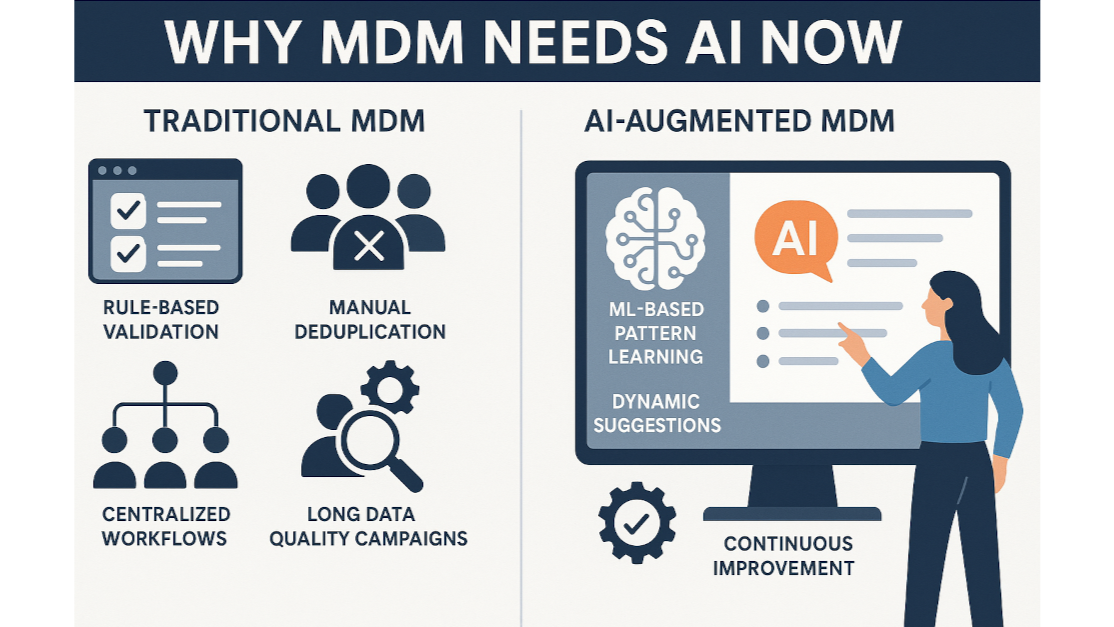
Traditional MDM systems are built for stability, not speed or flexibility.
They struggle when:
• New products are added weekly from different systems
• Customer data comes in 15 formats from 6 CRMs
• Business teams expect real-time insights, not quarterly syncs
And worse: the cost of keeping everything clean and consistent scales linearly with your data.
More volume? More people. More time. More budget.
• Auto-classify new entries (products, vendors, customers) across domains
• Detect duplicates with contextual understanding, not just field matching
• Suggest golden records by analyzing behavioral and transactional patterns
• Understand semantics behind labels like “client”, “customer”, “B2B partner”
In short: We can teach the machine how we do stewardship—and let it scale. Again, it won’t replace data stewards, since AI is not foolproof.
________________________________________
Traditional MDM AI-Augmented MDM
Rule-based validation Versus ML-based pattern learning
Manual deduplication Versus AI-based fuzzy + semantic matching
Slow onboarding of new domains Versus LLMs automate mapping & entity recognition
Centralized, hard-coded workflows Versus Contextual, dynamic suggestions for workflows
Long data quality campaigns Versus Continuous improvement via AI feedback loops
Vendors are already moving in this direction: enhancing their platforms with AI-assisted classification, semantic matching, and generative mapping capabilities, often building roadmaps that blend automation with explainability.
You don’t need a greenfield project. You need augmentation, not disruption. In other words, it’s about layering AI alongside your existing MDM stack—bringing intelligence to the workflows without tearing them apart.
________________________________________
Of course, there are risks. AI won’t fix broken governance or a missing strategy.
What matters most:
• Trust layer: You need explainability and auditability. No black-box decisions on master data. Therefore, POC both the vendor’s solution and any parallel AI solutions to prevent bad surprises.
• Governance first: AI learns from your data. If it’s messy, so is the output.
• Training the machine: Your stewards become teachers. Their interactions fuel the models, but the solutions cannot be left alone, they require continuous oversight and guidance.
The message is clear: don’t fear the machine. Feed it wisely—and keep it under proper oversight.
________________________________________
If your MDM feels like a burden in 2025, not an accelerator—ask yourself:
Have you tried adding AI into the workflow? Or are you still waiting for the perfect data before you do? Remember that the impact of AI on MDM can be measured and improved over time. One effective approach is to avoid vendor lock-in by running AI engines in parallel with your MDM solutions, enhancing the tasks without being tied directly to the core processes.
Because waiting won't help. AI thrives in imperfect systems with imperfect data, as long as you're willing to teach it.
________________________________________
Are you exploring AI for data stewardship?
Have you seen results (or resistance)?
Would you trust an LLM to suggest your golden record?
Let’s discuss 👇
About the Author
Axel Douchin is a Cloud, Data, and Artificial Intelligence (AI) executive and interim CIO, CTO, and Chief Data Officer specializing in complex digital transformation programs. With more than 20 years of international experience—including leadership roles in global technology initiatives and work with Amazon Web Services—he helps organizations design and execute large-scale cloud migrations, enterprise data strategies, and AI-driven platforms. His work focuses on data governance, scalable cloud architectures, and pragmatic approaches to deploying AI in regulated and high-complexity environments.
Topics: Cloud Strategy · Data Governance · Enterprise Data Platforms · Artificial Intelligence · Digital Transformation
More insights on Cloud, Data, and AI strategy:
www.douchinconsulting.com
#DataGovernance #Master Data Management #AI #MDM #GenerativeAI #LLM #DataStewardship #CloudTransformation #CIO #CDO
Expert analysis on data, cloud, and change management.
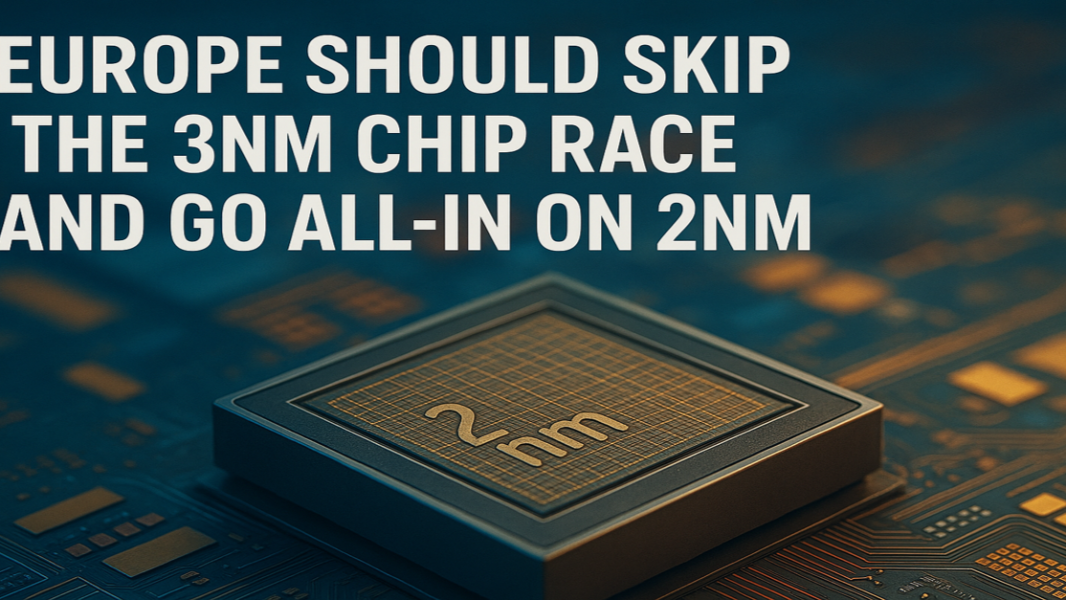
Europe can't afford to play catch-up. While others race to 3nm, we should leap directly to 2nm, just like Japan is doing with Rapidus. It’s bold, risky, and exactly what we need. In this article, I argue why Europe should go all-in on 2nm and what it would take to make it happen.
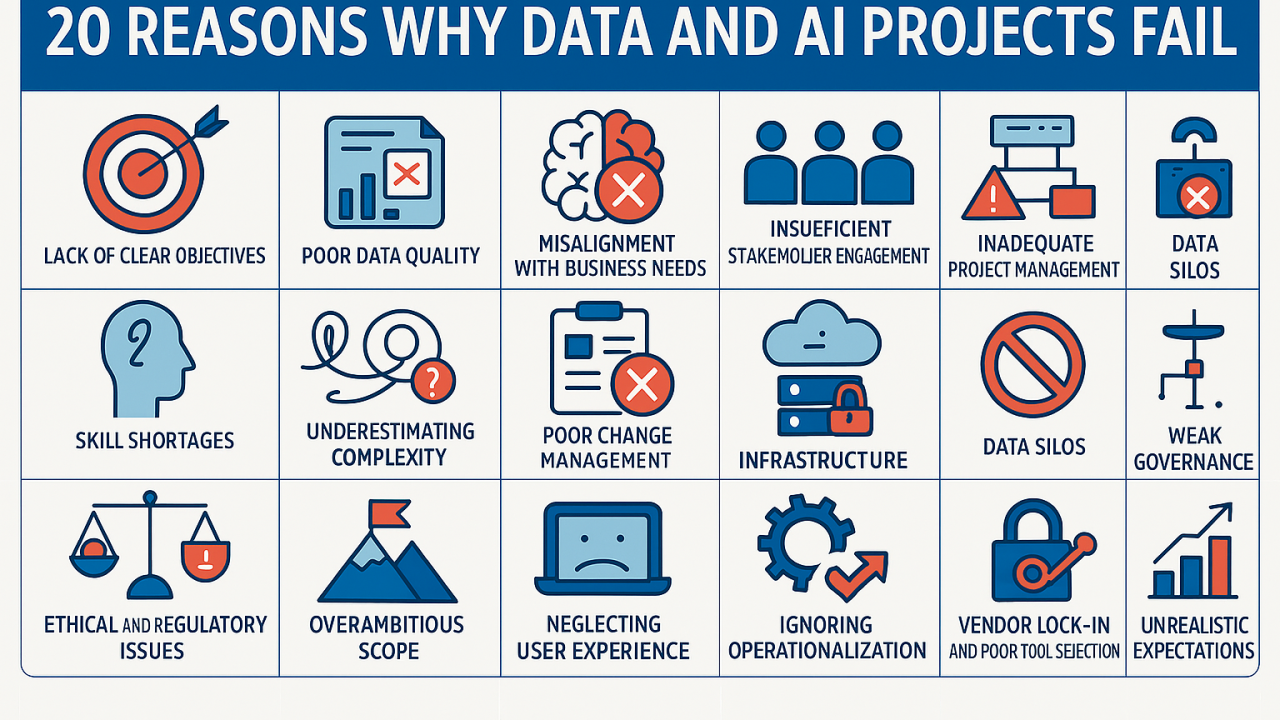
Avoid AI an Data failure, learn from other company's mistakes
Frustration has always been very high with BI solutions. breaking models and dashboards has always been an issue. It often required to prevent end users to create what ever they wanted for governance sake.
Expert guidance for seamless cloud and data transitions. Unlock value, ensure compliance, and lead with confidence.